
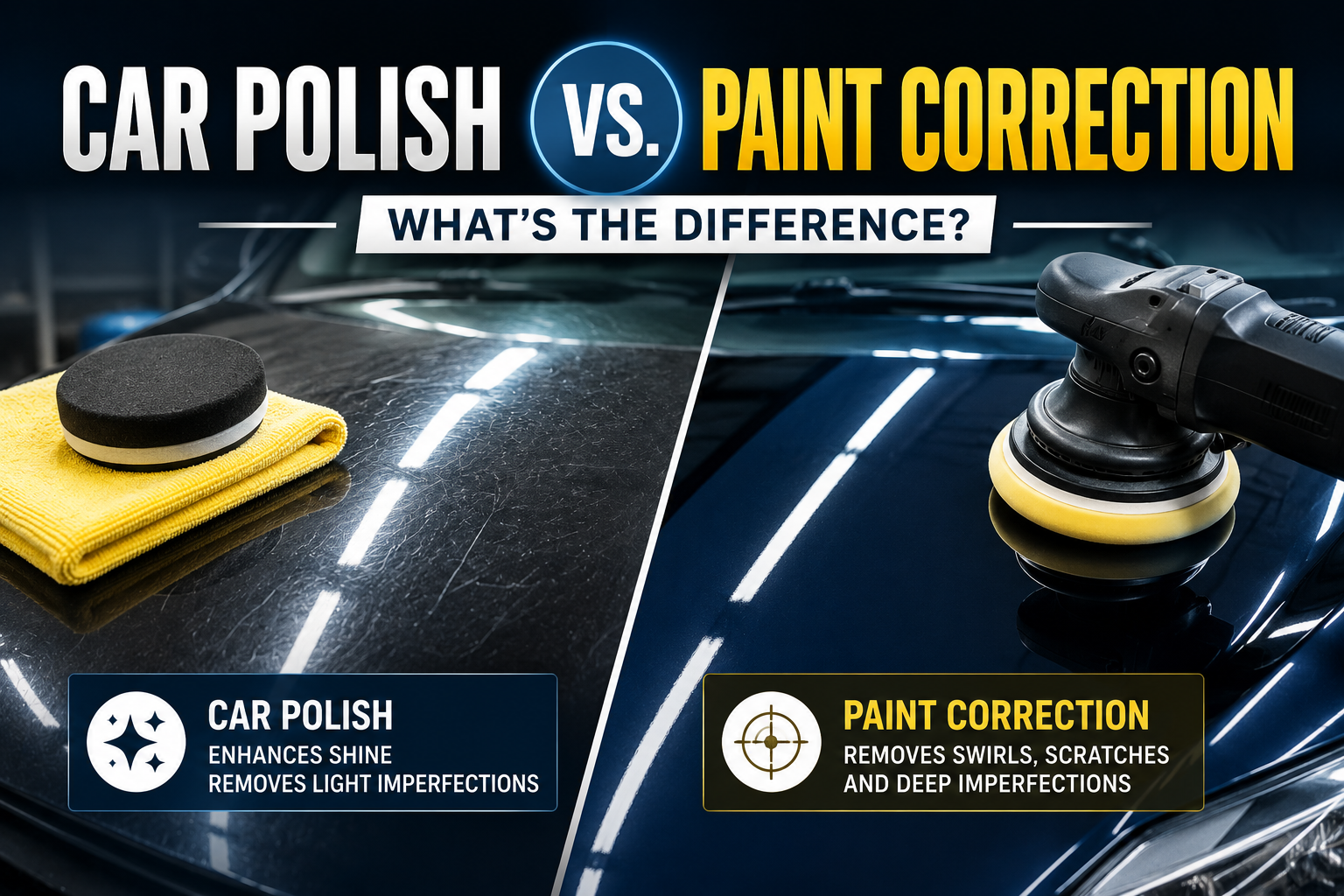
A dull finish, swirl marks, light scratches, and oxidation can make an otherwise well-maintained vehicle look older than it is. Two services commonly used to improve the appearance of automotive paint are car polish and paint correction. Although they can produce similar-looking improvements, they are not the same process.
Understanding the difference between car polish vs paint correction can help you choose the right approach for your vehicle. Polishing is generally suited to improving gloss and addressing minor surface imperfections, while paint correction is a more involved process designed to correct more noticeable paint defects.
In this guide, we’ll explain how each process works, what imperfections they can address, how they differ in intensity and results, and how to determine which option may be appropriate for your vehicle.
What Is Car Polish?
Car polish is a product and process used to refine the surface of a vehicle’s paint. Polishes contain fine abrasives that work against the clear coat to reduce or refine minor surface imperfections while improving clarity and gloss.
Over time, everyday driving can leave paint looking less vibrant. Washing, drying, road debris, environmental exposure, and improper cleaning techniques can contribute to fine marks and a hazy appearance. Car polishing can help refresh the finish without requiring an intensive correction process in every situation.
How Does Car Polish Work?
A polish contains microscopic abrasive particles that gradually refine the upper surface of the clear coat. When applied correctly, these abrasives can reduce the appearance of very fine imperfections and create a smoother, more reflective finish.
The amount of correction achieved depends on the polish, pad, equipment, technique, and condition of the paint. A professional may adjust the polishing approach based on the vehicle’s finish rather than using the same process for every car.
The goal isn’t simply to make the paint shiny. Proper polishing should improve the clarity and uniformity of the finish while preserving as much of the vehicle’s clear coat as reasonably possible.
What Can Car Polish Improve?
Car polish is generally most appropriate for relatively minor paint imperfections, including:
- Light swirl marks
- Fine surface scratches
- Slight oxidation
- Minor hazing
- Dull-looking paint
- Reduced gloss
- Very light surface imperfections
For a vehicle that still has healthy paint but has gradually lost some of its shine, professional car polishing can provide a noticeable cosmetic improvement.
What Can’t Car Polish Fix?
Polishing has limitations. It isn’t designed to repair every type of paint damage.
For example, car polish generally cannot safely eliminate:
- Deep scratches that extend through the clear coat
- Severe paint damage
- Areas where paint has been removed
- Major clear-coat failure
- Significant peeling or flaking
Trying to remove a deep defect by repeatedly polishing the surrounding paint can remove more clear coat than is appropriate without actually eliminating the damage.
That’s one reason it’s important to assess the depth and severity of an imperfection before deciding which paint-care process to use.
What Is Paint Correction?
Paint correction is a more intensive process designed to reduce or remove visible imperfections in a vehicle’s paint finish. Rather than simply improving gloss, the objective is to correct defects that make the paint appear scratched, hazy, cloudy, or uneven.
Depending on the condition of the vehicle, paint correction can involve multiple stages of machine polishing using different pads and compounds. The specific approach depends on the type and severity of the imperfections, as well as the condition and thickness of the paint.
Unlike a basic polish intended primarily to refresh the finish, paint correction focuses more heavily on defect removal and paint refinement.
The right approach isn’t always the most aggressive one. Removing paint imperfections involves working with the vehicle’s clear coat, so correction should be performed carefully to achieve the desired improvement without unnecessarily compromising the finish.
What Problems Can Paint Correction Address?
Depending on the depth and severity of the damage, paint correction can help reduce the appearance of several common paint imperfections, including:
- Swirl marks
- Fine to moderate scratches
- Water spots
- Oxidation
- Paint haze
- Surface imperfections
- Loss of clarity and gloss
The results will vary from vehicle to vehicle. Some imperfections can be substantially reduced or removed, while others may require a different type of repair.
How Is Paint Correction Different From Simple Polishing?
The terms car polish and paint correction are sometimes used interchangeably, but they describe different levels of paint refinement.
| Car Polish | Paint Correction |
| Generally focuses on improving gloss and refining the finish | Focuses on reducing or removing more noticeable paint defects |
| Best suited to minor surface imperfections | Better suited to more extensive imperfections |
| May require less intensive work | Can involve multiple correction stages |
| Provides a refreshed, more reflective appearance | Can produce a more significant transformation |
| Often appropriate for relatively well-maintained paint | Requires a careful assessment of the paint condition |
In other words, polishing can be considered a lighter approach to paint refinement, while correction is more focused on addressing specific defects.
However, there isn’t always a strict line between the two. Professional paint correction in Ventura can involve polishing as part of the overall process. What matters most is the condition of the vehicle’s paint and the level of improvement needed.
Does Paint Correction Remove All Scratches?
No. One of the biggest misconceptions about paint correction is that it can remove every scratch from a vehicle.
A scratch that only affects the upper portion of the clear coat may be reduced or removed through appropriate correction. However, deeper scratches that extend through the clear coat and into the underlying paint or body material may not be safely removable through polishing.
Trying to remove a deep scratch completely could require removing too much surrounding clear coat. In some cases, the safest option is to reduce the appearance of the scratch rather than attempt complete removal.
A professional car assessment can help determine:
- How deep the scratch is
- Whether it can be corrected
- How much correction is appropriate
- Whether another type of repair may be necessary
This is particularly important when dealing with older paint or vehicles that have already undergone previous polishing or correction.
Car Polish vs. Paint Correction: Which One Does Your Car Need?
Choosing between car polish vs paint correction largely comes down to the condition of your vehicle’s paint and what you want to accomplish.
If your vehicle has generally healthy paint but looks dull or has light swirl marks, polishing may be enough to restore a cleaner, glossier appearance.
If the paint has more noticeable scratches, heavy swirl marks, oxidation, or multiple surface defects, a more comprehensive correction process may be appropriate.
When Should You Choose Car Polish?
Car polish in Ventura may be a suitable option when your vehicle has:
- Minor swirl marks
- Light surface imperfections
- Slight oxidation
- General dullness
- Reduced gloss
- A finish that needs refreshing
For example, a newer vehicle that has been properly maintained but has developed light washing marks may benefit from a polishing treatment rather than a more intensive correction.
When Does Your Car Need Paint Correction?
A vehicle may be a better candidate for paint correction when it has:
- Extensive swirl marks
- Noticeable scratches
- Heavy oxidation
- Significant paint haze
- Multiple visible surface defects
- A finish that remains dull despite basic polishing
The condition of the paint should always be assessed before deciding on the level of correction. More correction isn’t automatically better. The objective is to achieve a noticeable improvement while preserving the integrity of the paint.
Car Polish vs. Paint Correction: Key Differences
Now that you understand both processes, the easiest way to compare car polish vs paint correction is to look at what each one is designed to accomplish. Although both can improve the appearance of your vehicle’s finish, the level of correction, time involved, and expected results can be quite different.
Difference in Purpose
The primary purpose of car polish is to refine the paint and improve its appearance. It can help reduce the visibility of minor imperfections while bringing back some of the gloss and clarity that the finish may have lost.
Car paint restoration, on the other hand, focuses more heavily on correcting visible defects. It is typically used when a vehicle has more pronounced swirl marks, scratches, oxidation, or other imperfections that require a more intensive approach.
Neither option is automatically better. The appropriate service depends on the condition of your paint and the result you want to achieve.
Difference in Level of Correction
Polishing generally involves a lighter level of paint refinement. It can be an excellent choice when the paint is in relatively good condition but needs a refresh.
Paint correction can involve multiple stages and different levels of abrasiveness depending on the defects being addressed. A technician may begin with a less aggressive approach and increase the level of correction only when necessary. Restore your vehicle’s shine with either option based on your vehicle’s requirements.
This measured approach is important because the clear coat is a finite layer. Removing more material than necessary isn’t beneficial simply because a defect is visible.
Difference in Time and Cost
The amount of time and labor involved can also differ.
A straightforward polishing service may require less preparation and fewer correction stages. More extensive paint correction service in Ventura can take considerably longer because the vehicle’s paint needs to be carefully evaluated, corrected, and refined.
Cost can vary based on factors such as:
- Vehicle size
- Paint condition
- Number and severity of defects
- Type of paint
- Amount of correction required
- Number of correction stages
For that reason, there isn’t one standard price for either service. A professional assessment provides a more accurate idea of what your vehicle needs.
Difference in Results
Both car polishing and paint correction can improve gloss and clarity, but the visual difference can vary significantly depending on the starting condition of the paint.
Polishing your vehicle’s paint in Ventura may be enough to give a well-maintained vehicle a noticeably cleaner and brighter finish. Paint correction can create a more dramatic transformation when swirl marks, scratches, oxidation, and other imperfections are more prominent.
However, the best result isn’t necessarily the one that removes every visible defect. A professional should balance the desired appearance with the condition and remaining thickness of the paint.
When Should You Choose Car Polish?
Car polish is generally a good choice when your vehicle’s paint is in relatively good condition but has lost some of its gloss or developed minor imperfections.
Consider polishing if you notice:
- Light swirl marks
- Minor surface scratches
- Slight oxidation
- Dull or hazy paint
- Reduced paint clarity
- A finish that simply looks tired
Polishing can be especially useful as part of ongoing paint care. Rather than waiting until the finish develops extensive defects, maintaining the paint appropriately can help preserve its appearance.
If your primary goal is to restore your vehicle’s shine and improve the finish without extensive correction, polishing may be the more appropriate option.
When Does Your Car Need Paint Correction?
A more intensive paint correction service may be worth considering when your vehicle has noticeable defects that go beyond what a basic polish is intended to address.
Signs that your vehicle may benefit from correction include:
- Numerous swirl marks
- Visible scratches
- Heavy oxidation
- Significant haze
- Widespread surface imperfections
- A finish that remains dull after lighter polishing
Paint correction can be particularly beneficial for vehicles that have experienced years of automatic car washes, improper washing techniques, environmental exposure, or inconsistent paint care.
If you’re in Ventura and considering automotive paint correction service in Ventura, having the vehicle assessed first can help determine the appropriate level of correction. This avoids taking an unnecessarily aggressive approach when a lighter treatment may achieve the desired result.
Can You Polish a Car Before Paint Correction?
Yes. Polishing can be part of a broader paint correction process.
Depending on the condition of the paint, correction may involve several stages, with each stage designed to progressively refine the finish. A technician may use a more aggressive compound initially to address certain defects and then follow it with finer polishing steps to improve clarity and gloss.
However, not every vehicle requires multiple stages. A relatively well-maintained finish may need only light polishing, while heavily marked paint may require a more comprehensive correction process.
The important thing is to match the process to the condition of the paint rather than automatically choosing the most intensive treatment. A professional evaluation can help determine whether your vehicle needs a simple polish, more extensive correction, or another solution altogether.
How to Decide Between Car Polish and Paint Correction
Choosing between car polish vs paint correction ultimately depends on the condition of your vehicle’s paint and the level of improvement you’re looking for. A professional assessment is the best way to determine which approach makes sense, but this quick guide can help you understand the basic difference.
| If Your Paint Has… | Consider… |
| Minor dullness | Car polish |
| Light swirl marks | Car polish |
| Slight oxidation | Car polish |
| Fine surface imperfections | Car polish |
| Noticeable scratches | Paint correction |
| Heavy swirl marks | Paint correction |
| Significant oxidation | Paint correction |
| Widespread paint imperfections | Paint correction |
| Deep scratches | Professional assessment |
Keep in mind that these are general guidelines. The condition of your clear coat, the depth of the imperfections, and previous paint treatments can all affect what approach is appropriate.
Why a Professional Paint Assessment Matters
It’s tempting to choose a more aggressive correction simply because you want the most dramatic result. However, paint correction should be approached carefully.
Every vehicle has a finite amount of clear coat, and removing more material isn’t always the right solution. A professional can evaluate the condition of the paint and determine how much correction is appropriate.
An assessment can help identify:
- The type of paint defects present
- Whether imperfections are superficial or deeper
- The condition of the clear coat
- How much correction may be possible
- Whether polishing or correction is the better option
- Whether certain defects require a different repair
This approach helps balance appearance with long-term paint preservation.
Keep Your Car Clean With Five Points Car Wash
If you drive regularly around Ventura and find yourself visiting the car wash several times a month, an unlimited wash membership can make routine vehicle cleaning more convenient. Five Points Car Wash offers wash options for local drivers who want an easier way to keep up with regular vehicle care.
Before choosing a membership, consider how often you wash your vehicle and the driving conditions it encounters. If you frequently deal with Ventura’s coastal roads, beach trips, dust, or everyday road grime, having convenient access to regular washes can help you maintain a cleaner vehicle throughout the year.
Contact Five Points Car Wash to explore the available wash and membership options and find the one that fits your Ventura driving routine.
Frequently Asked Questions
1. What is the difference between car polish and paint correction?
Car polish generally focuses on improving gloss and addressing minor surface imperfections. Paint correction is a more intensive process designed to reduce or remove more noticeable defects such as swirl marks, scratches, and oxidation.
2. Is car polish the same as paint correction?
No. Although polishing can be part of a paint correction process, the two aren’t necessarily the same. Paint correction typically involves a more comprehensive approach to reducing paint defects.
3. Does car polish remove scratches?
Car polish can reduce or remove some very fine surface scratches and imperfections. Deeper scratches may extend beyond the clear coat and cannot always be safely removed through polishing.
4. Can paint correction remove deep scratches?
It depends on the depth of the scratch. Defects limited to the clear coat may be significantly reduced or removed, while deeper scratches may require a different type of repair.
5. Is paint correction better than polishing?
Neither is automatically better. Polishing may be sufficient for a vehicle with minor imperfections, while paint correction may be more appropriate for significant or widespread paint defects.
6. How often should you polish your car?
There is no universal schedule. How often your vehicle should be polished depends on its paint condition, exposure, washing habits, and how frequently imperfections develop. Excessive polishing should be avoided because clear coat is limited.
7. How long does paint correction last?
The longevity of the results depends on how the vehicle is washed, maintained, stored, and exposed to environmental conditions. Proper ongoing paint care can help preserve the corrected finish.
8. Is paint correction safe for car paint?
When performed correctly, paint correction can be safe for the vehicle’s finish. The process should be tailored to the condition of the paint, with as little clear-coat removal as reasonably necessary.
9. How do I know if my car needs polishing or paint correction?
Light dullness, fine swirl marks, and minor surface imperfections may respond well to polishing. More noticeable scratches, heavy swirl marks, oxidation, and widespread defects may call for paint correction. A professional assessment can provide a more accurate recommendation.
10. Where can I get car polishing or paint correction in Ventura?
Five Points Car Wash serves Ventura-area drivers looking for professional vehicle care, including services designed to improve and maintain their vehicle’s appearance. If your car needs help with dull paint, swirl marks, or other surface imperfections, a professional assessment can help determine which paint-care service is appropriate for your vehicle.